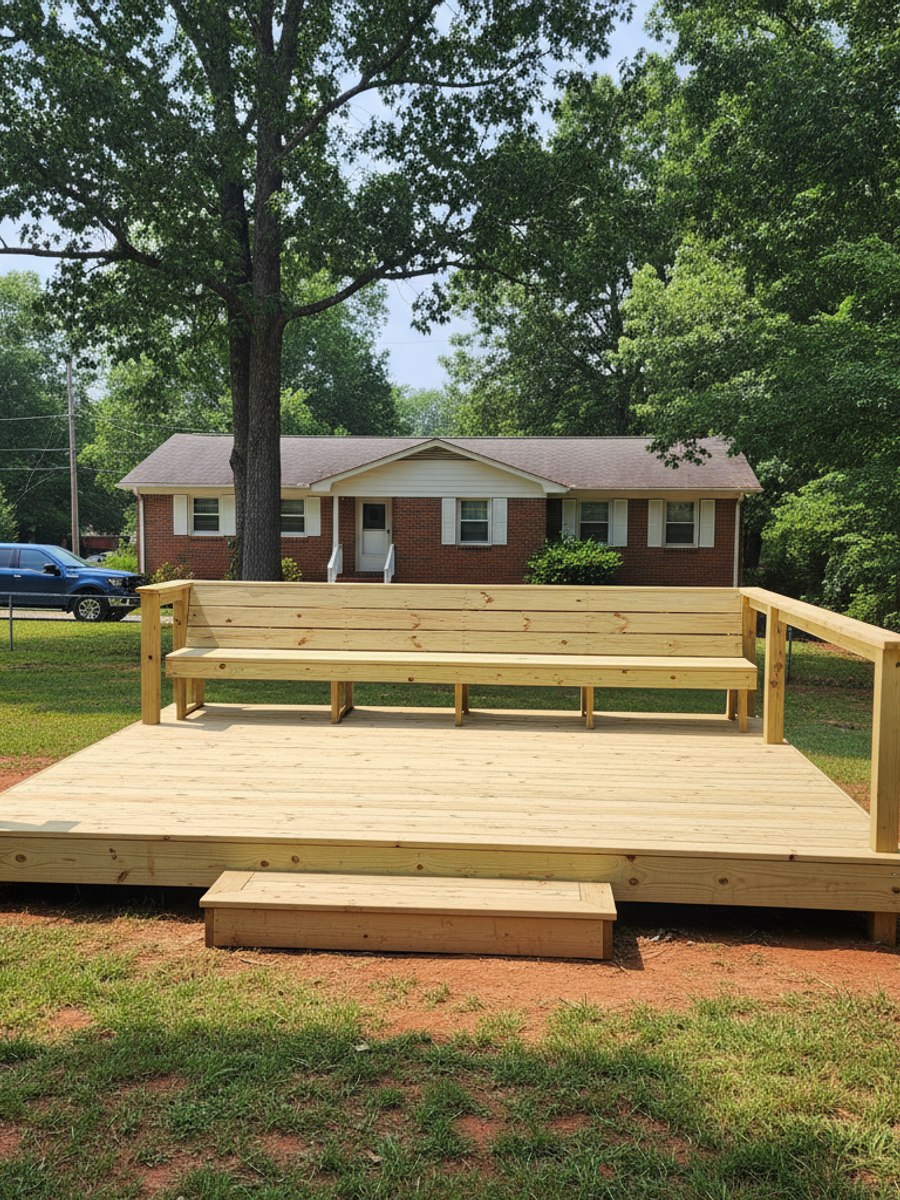
A deck looks simple from the top. Boards, some railing, maybe a set of stairs down to the yard. What's underneath is where a build either holds up for 25 years or starts wobbling by year four, and most homeowners never see that part until something's already wrong. Here's what to actually check before you sign a contract.
Ask who pulls the permit, not whether one is needed
Cobb County requires a building permit for most attached decks and for any deck over a certain height off the ground. A builder who tells you "we don't bother with that one, it's small" is telling you they cut that corner on other jobs too. The permit process matters because it forces two inspections that actually protect you: one at the footing stage, before any decking goes down, and one at final framing. If a contractor is confident in the work, they want the inspector to see it. If they're rushing or underbuilding, they'll talk you out of pulling one.
Ledger board attachment is usually the single item a Cobb County inspector will flag first. It has to be lag-bolted or through-bolted into the house rim joist, not just nailed, and it needs proper flashing to keep water from running behind it and rotting the band board. That flashing detail is invisible once the decking's on. Ask to see it before it's covered up.
Understand what the soil under your deck is doing
Most of Mableton and the rest of Cobb County sits on red clay. Clay holds water, then shrinks hard when it dries out, and that movement is what pushes footings around over time if they're set too shallow. A footing poured 8 inches down in clay might look fine the day it's poured and start heaving or settling unevenly two summers later. Codes here generally call for footings around 12 inches in diameter and set below the frost and into undisturbed soil, not the loose fill that gets kicked back into the hole. Ask your builder how deep they're going and whether they're pouring against undisturbed clay or backfilled dirt. If they shrug, that's a problem.
Digging in Cobb clay after a rainy stretch is its own headache. It turns to something close to modeling clay, sticks to the auger, and doesn't compact the same way once disturbed. A crew that's worked here knows to time footing digs around dry stretches, or to hand-tamp and inspect the hole before pouring rather than assuming it's solid.
Materials that actually hold up in Georgia summers
Pressure-treated pine is still the standard for framing, and it's fine, but the chemical treatment (ACQ) is corrosive to plain galvanized fasteners and joist hangers. You want hot-dip galvanized or stainless hardware rated for ACQ contact, not the cheaper hardware store connectors. This is a small cost difference and a real one for how long the frame lasts.
On decking boards, whether you go with treated pine, cedar, or composite, gaps between boards matter more here than in a dry climate. Georgia humidity swings hard between a wet spring and a July that sits in the 90s for weeks, and wood moves with it. Composite decking expands with heat too, more than most people expect, so board spacing and fastening have to account for that or you get buckling by the second summer. A builder who installs decking tight with no gap either hasn't done many of these or is rushing to finish.
What the neighborhood tells you
Older streets around Mableton, closer to Floyd Road and the original part of town, often have decks from the 70s and 80s that were nailed together with no flashing and no permit history at all. If you're replacing one of these, expect the ledger and rim joist to need real inspection, not just a new coat of stain over old problems. Newer subdivisions off Mableton Parkway and toward Vinings often have an HOA, and HOAs commonly require design approval before you build, sometimes down to the railing style and stain color. A builder who's done work in your specific subdivision has usually already dealt with that board and knows what gets approved without a fight. Worth asking directly.
Red flags worth walking away from
- A quote that's dramatically lower than two others for the same footprint and material. Someone's cutting footing depth, fastener grade, or both.
- No written contract, or a contract with no start and completion date on it.
- Payment demanded in full, upfront, in cash. A deposit is normal. All of it before a board is cut is not.
- No mention of a permit, ever, unless the deck is a small freestanding platform under the size threshold that doesn't need one.
- Can't tell you what fastener or hardware they use, or gets vague when asked about footing depth.
- No insurance certificate available on request. This one's non-negotiable. If someone falls off a ladder on your property mid-build, you don't want that liability landing on you.
What a decent timeline actually looks like
For a straightforward attached deck, permit approval in Cobb County typically takes one to a few weeks depending on the office's backlog, so a builder promising to start next week without a permit in hand is either skipping the permit or hasn't submitted yet. Once footings are poured, code usually calls for a few days' cure before framing loads them, longer in cooler weather. A full deck build, once permitted and started, commonly runs one to three weeks depending on size, railing complexity, and whether it's a straight rectangle or has multiple levels and stairs. Anyone promising a big custom deck finished in two days is either doing something small or not doing it right.
None of this is complicated once you know what to ask. It's just easy to skip if nobody tells you the questions. If you want a second opinion on a quote or a look at what a properly footed, properly flashed deck should cost in this area, that's the kind of question Oasis Deck Co gets asked all the time, and it's a fair one to ask before you sign anything.